Citi Bank Agent Assist
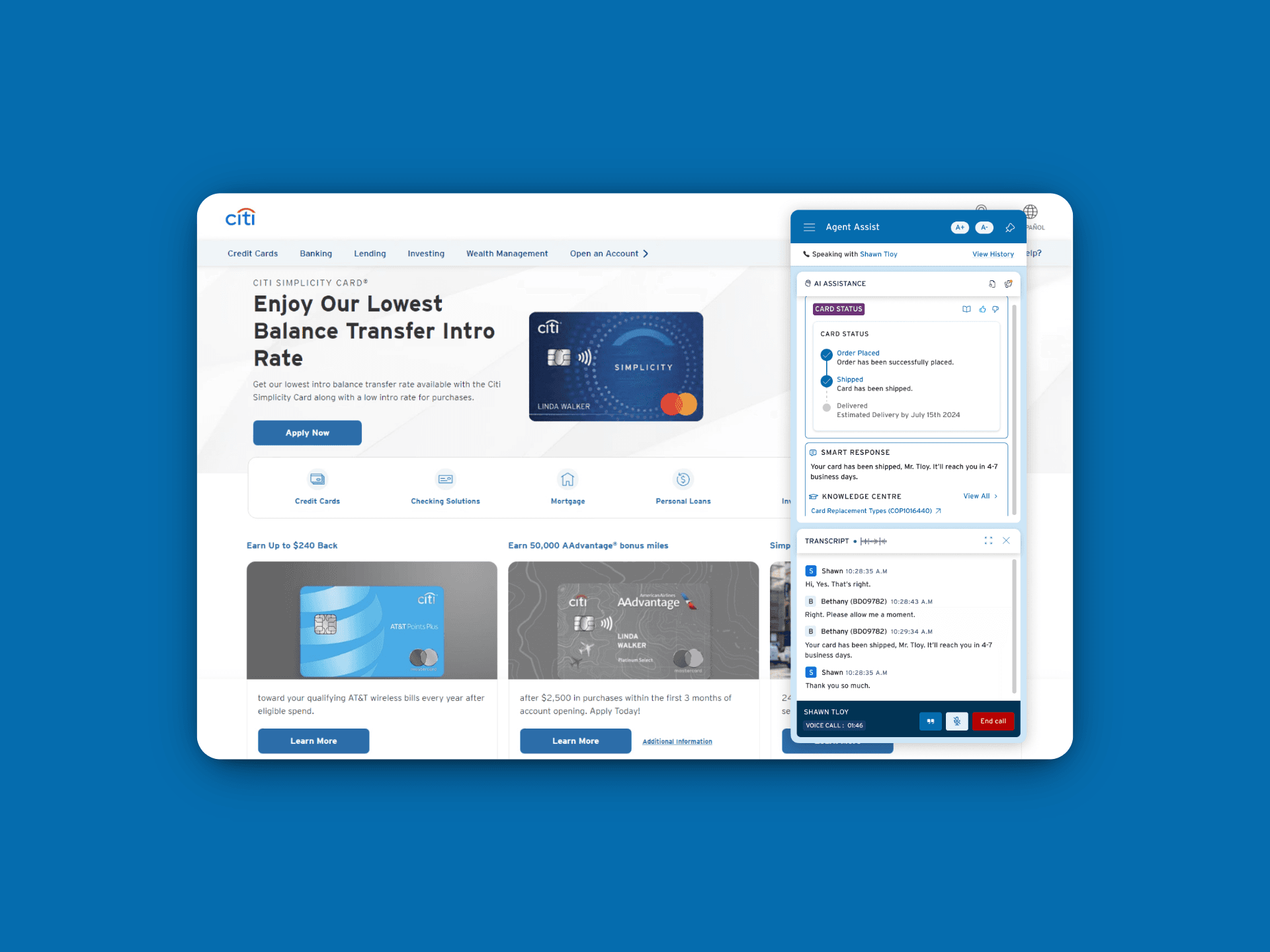
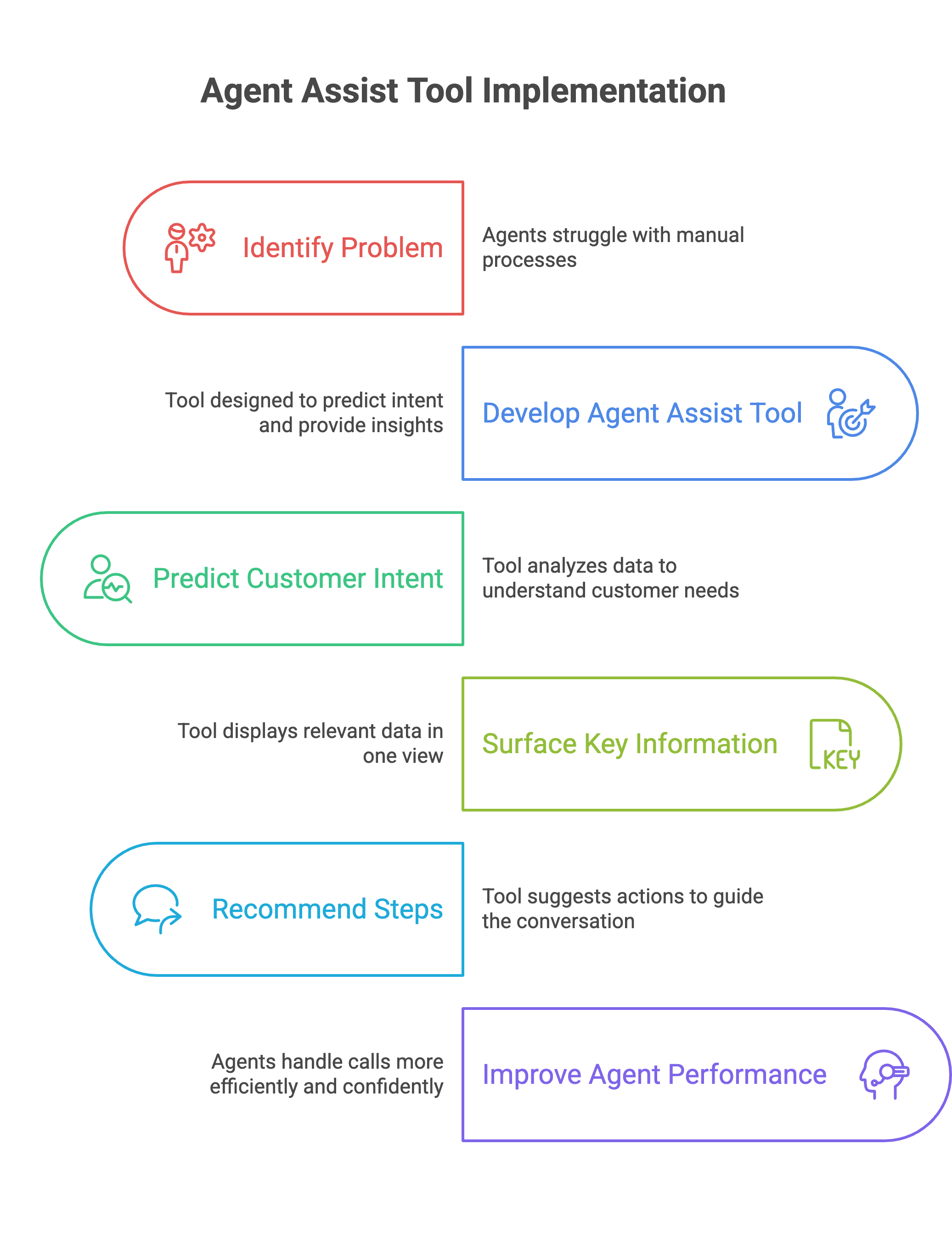
Customer support agents needed a better way to quickly understand the customer's intent and guide the conversation effectively. Without early insights, agents had to manually search through customer history, navigate multiple systems, and rely on memory to follow different processes for each line of business. This made it harder to maintain smooth conversations, leading to a 10-minute average handling time (AHT), inconsistent service, and agent fatigue. To solve this, we built an Agent Assist tool that predicted customer intent, surfaced key information in one view, and recommended the right steps to support the conversation. This helped agents quickly understand customer needs, provide consistent experiences, and handle calls with more confidence and less stress.
Role
Product Design and strategy
year
2025
Tags
Research, Design, B2B, AI, Visual Design
Overview
🚨 The Challenge
Customer service agents were handling hundreds of calls daily, but faced major hurdles
They had no idea why the customer was calling until the call began.
They manually dug through customer history, switching tabs and guessing solutions.
Every Line of Business(LOB) had its own unique process, agents had to memorize them all or would take time to surf around the knowledge centre hub.
This has caused agent burnout when customer asked complex questions, 10+ Minutes of Average Handling Time(AHT), inconsistent experiences.
Agents didn't just need another tool, they needed a smart assistant💻
💡 Our Vision
Imagine an intelligent co-pilot that
Listens to customer before the call(through IVR options).
Understands customer needs and also their emotions
Guides agents in real-time with smart workflows and suggestions
Learns from every interaction to continuously improve.
That’s what we built: Agent Assist.
Approach
📚Began with deep research and real-world
Shadowed 20+ live customer support calls to understand the workflow and how a case is handled
Interviewed Agents across five different LOBs
Mapped the complete agent journey(Pre-call → During Call → Post-call).
Key Findings
Agent Spent 40-60% of their time searching for the right next step across different articles surfed.
Teams had scattered internal playbooks, with no centralized system to pull the data.
Emotionally charged calls were harder and slower to resolve correctly.
Most of the process that has been done was manual
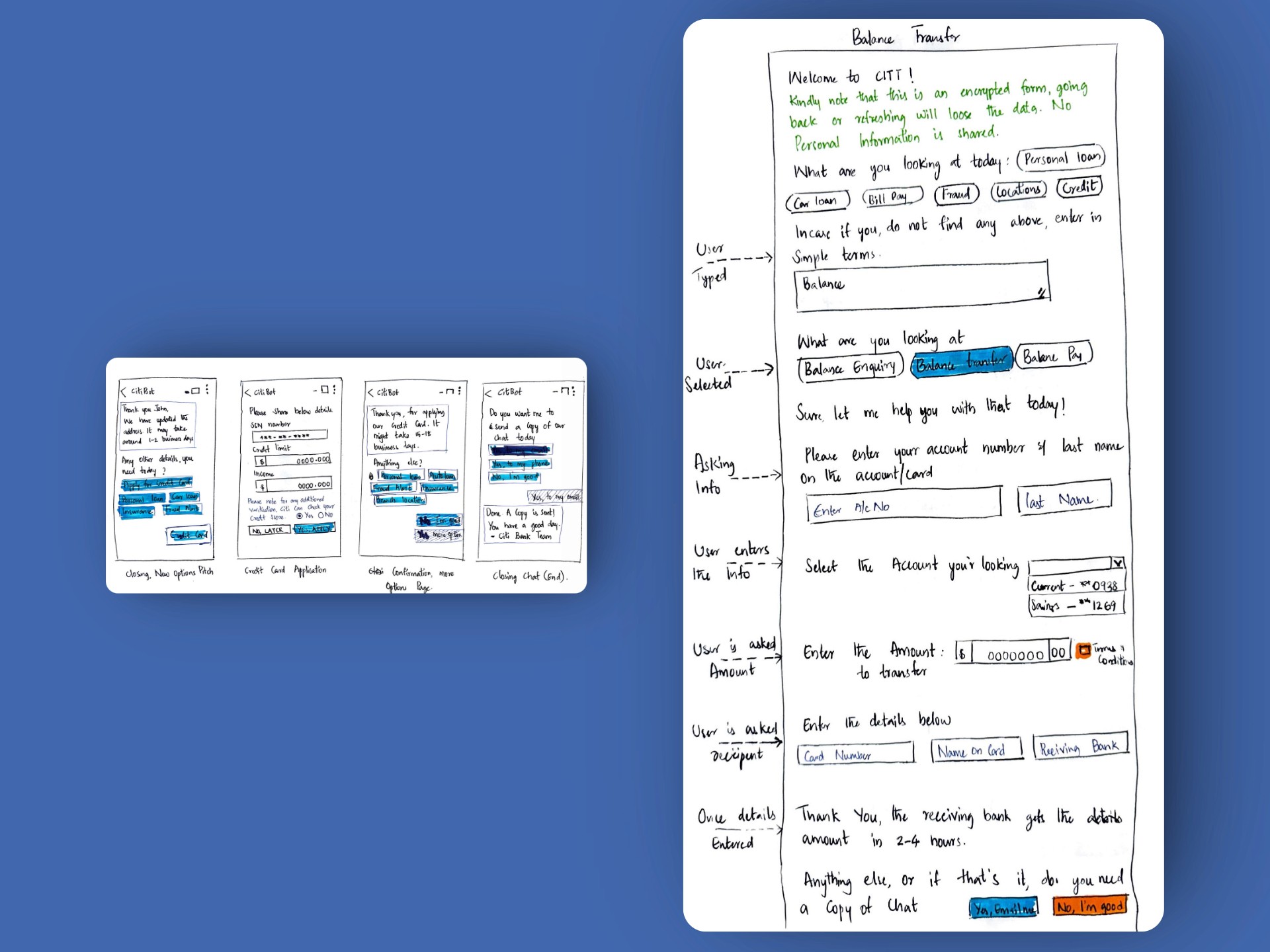
Post meeting some of the agents and understanding the journey, below are some sketches of our thoughts on how the system can be designed.
Results & Impact
What We Built
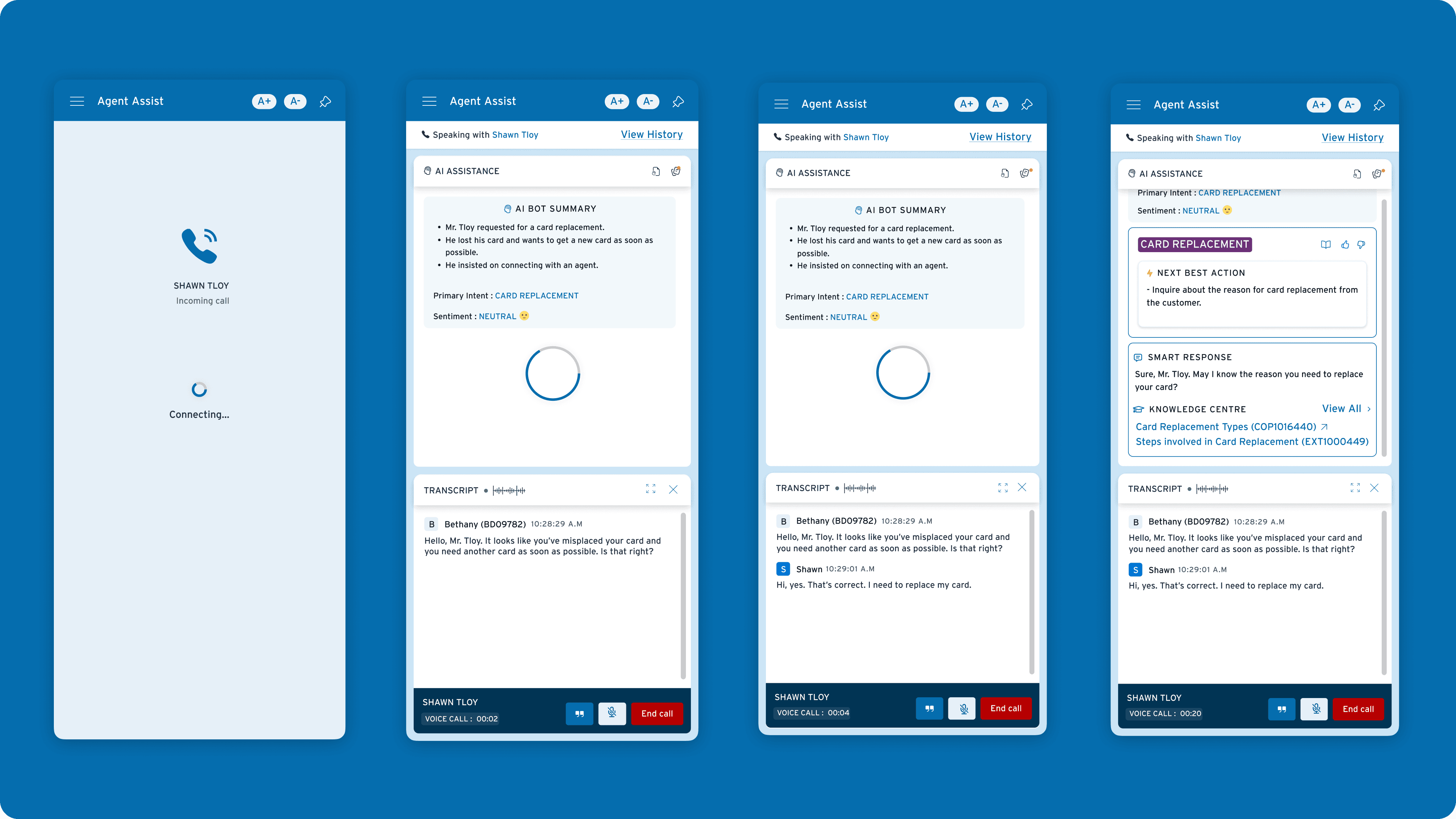
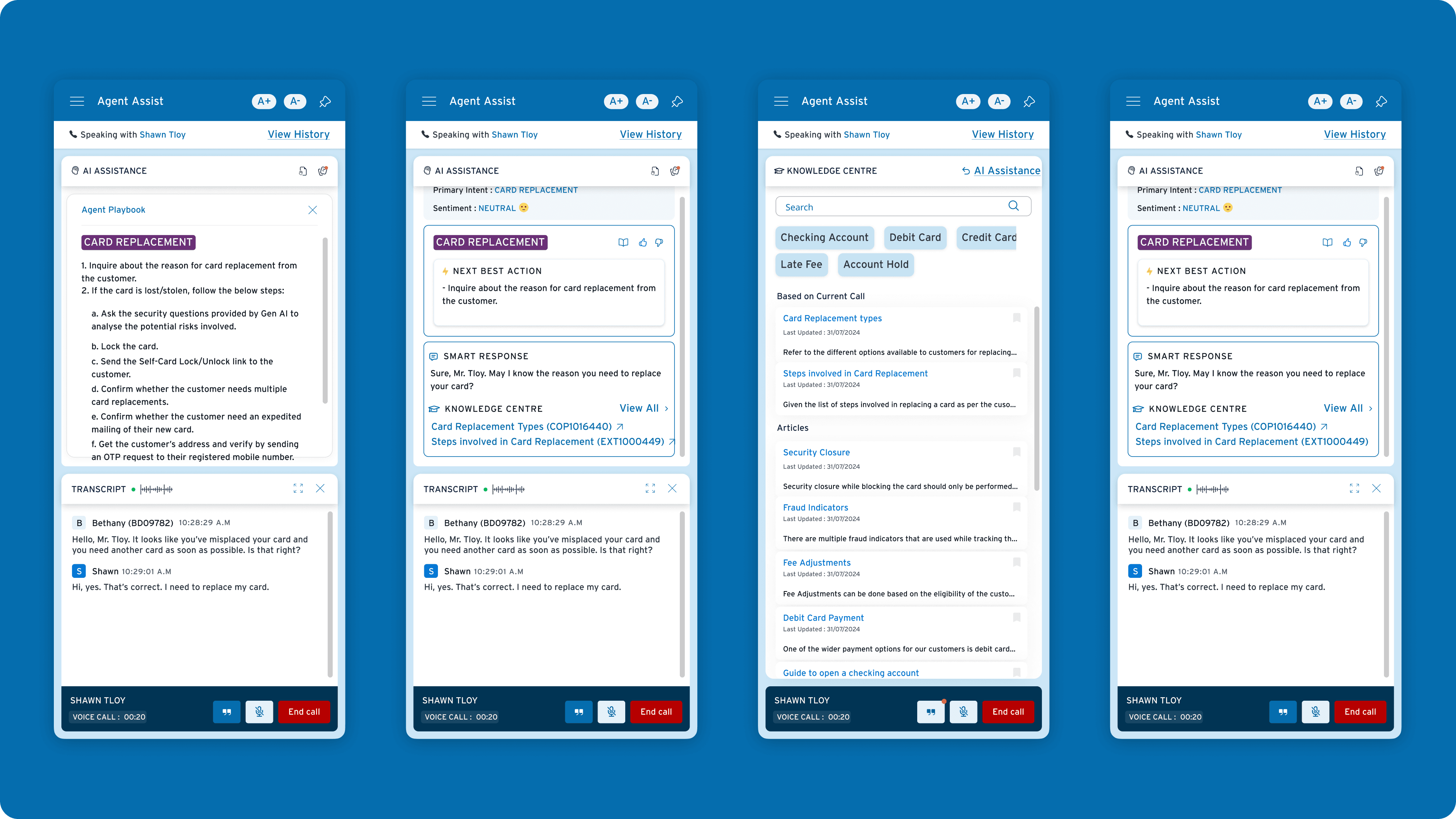
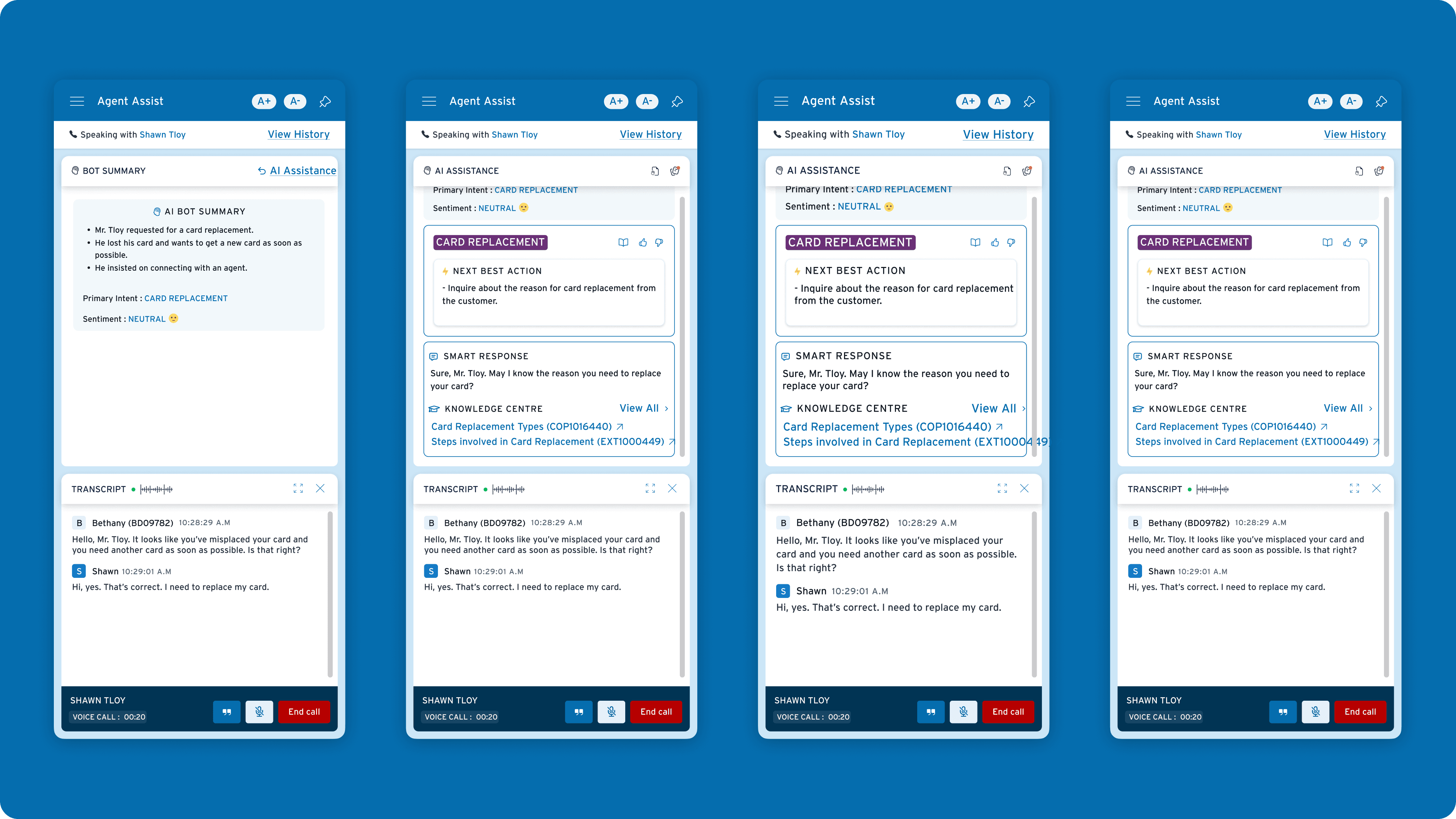
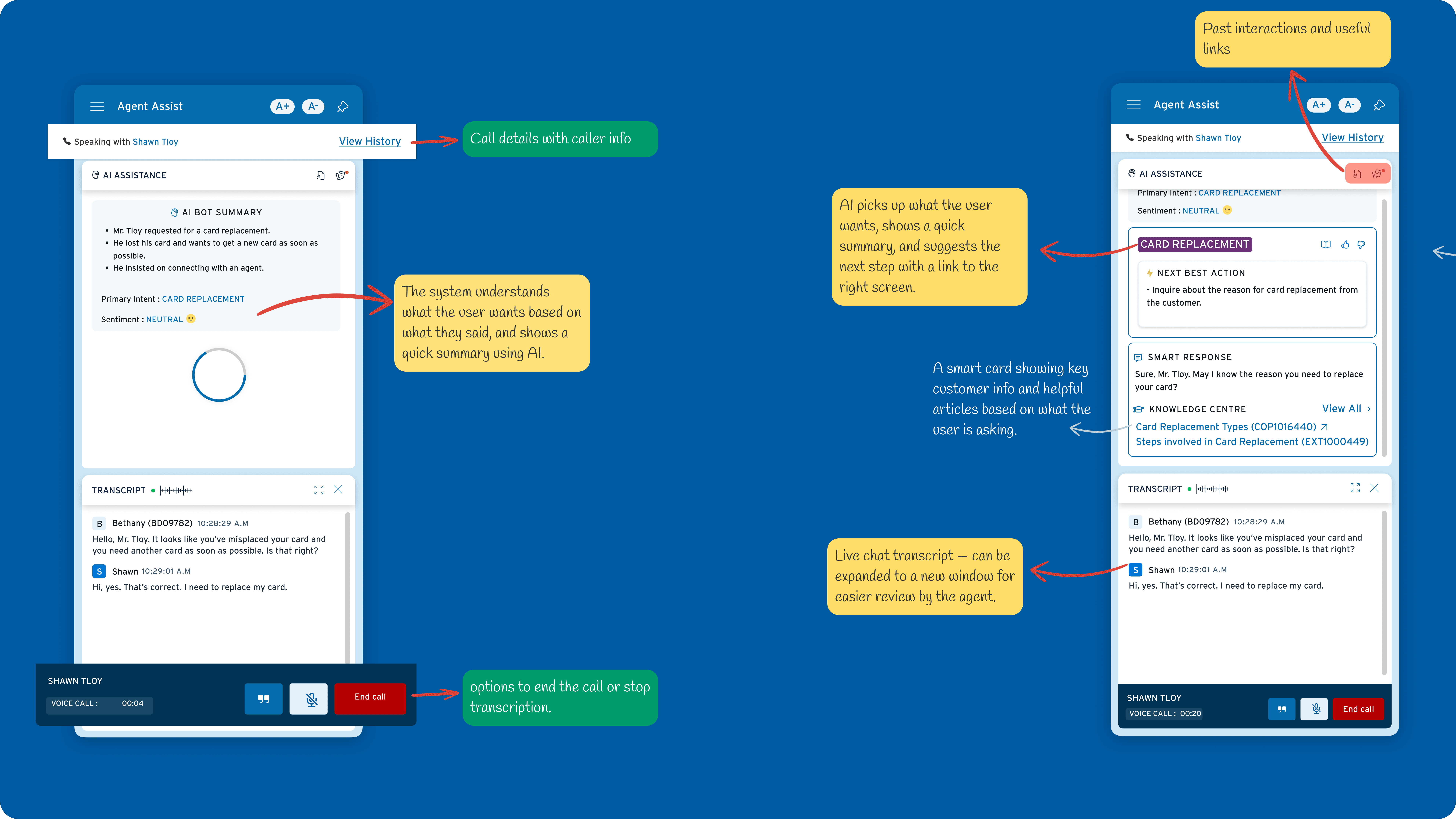
Pre-call Intelligence Integration: Captures account info, recent transactions, and call reason; detects caller tone and emotion via voice and NLP; sends real-time summaries to agents before calls start.
Intent Recognition with Gemini AI: Extracts key details, assigns confidence scores, and suggests next-best actions.
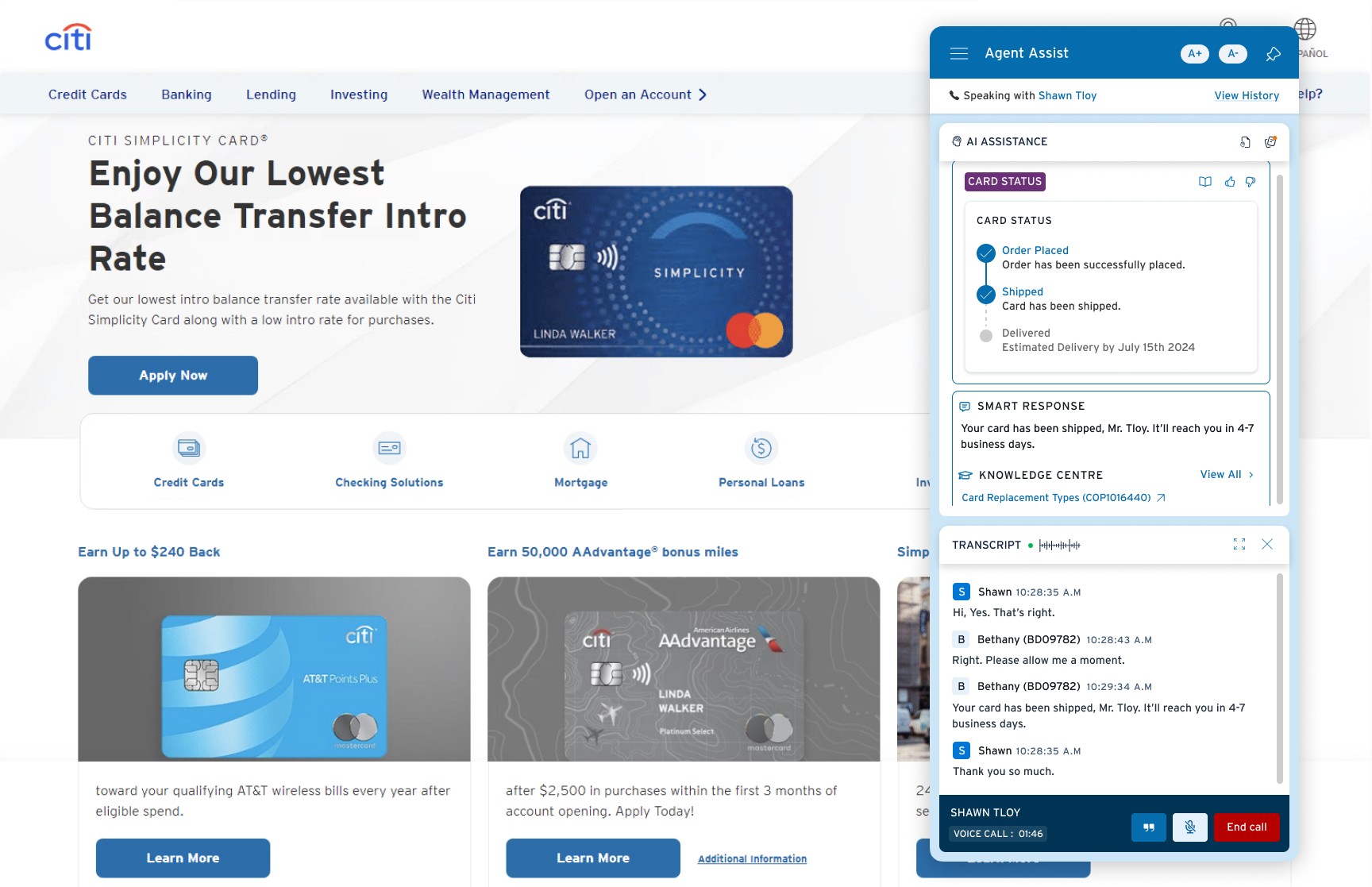
Contextual UI & IVR Integration: Provides smart suggestions and visualizes multi-intent calls as cards for seamless workflow switching.
Feedback-Driven Learning Loop: Agents can rate suggestions, enabling continuous AI retraining; dashboards track usage and accuracy.
Design Highlights
Empathetic prompts based on caller tone (e.g., “Use softer language,” “Confirm twice before proceeding”).
Multi-intent support with clear visualization for easy navigation.
Modular, plug-and-play components tailored to each Line of Business.
My Impact and learnings
Designed a helpful assist tool that helped 120 agents cut call times by about 40%, bringing calls down from 7–8 minutes to just 4–5 minutes.
Made it easier for agents to find the right knowledge articles quickly by using AI to understand what users said, cutting search time in half.
Built a feedback system that lets agents rate suggestions, which improved the AI’s accuracy by 25% over time.
Faced and solved many technical and design challenges, helping the project finish faster and work better for users.
Created thoughtful prompts that adjust based on the caller’s tone, making conversations smoother and boosting user satisfaction by 10%.
Citi Bank Agent Assist
Customer support agents needed a better way to quickly understand the customer's intent and guide the conversation effectively. Without early insights, agents had to manually search through customer history, navigate multiple systems, and rely on memory to follow different processes for each line of business. This made it harder to maintain smooth conversations, leading to a 10-minute average handling time (AHT), inconsistent service, and agent fatigue. To solve this, we built an Agent Assist tool that predicted customer intent, surfaced key information in one view, and recommended the right steps to support the conversation. This helped agents quickly understand customer needs, provide consistent experiences, and handle calls with more confidence and less stress.
Role
Product Design and strategy
year
2025
Tags
Research, Design, B2B, AI, Visual Design
Overview
🚨 The Challenge
Customer service agents were handling hundreds of calls daily, but faced major hurdles
They had no idea why the customer was calling until the call began.
They manually dug through customer history, switching tabs and guessing solutions.
Every Line of Business(LOB) had its own unique process, agents had to memorize them all or would take time to surf around the knowledge centre hub.
This has caused agent burnout when customer asked complex questions, 10+ Minutes of Average Handling Time(AHT), inconsistent experiences.
Agents didn't just need another tool, they needed a smart assistant💻
💡 Our Vision
Imagine an intelligent co-pilot that
Listens to customer before the call(through IVR options).
Understands customer needs and also their emotions
Guides agents in real-time with smart workflows and suggestions
Learns from every interaction to continuously improve.
That’s what we built: Agent Assist.
Approach
📚Began with deep research and real-world
Shadowed 20+ live customer support calls to understand the workflow and how a case is handled
Interviewed Agents across five different LOBs
Mapped the complete agent journey(Pre-call → During Call → Post-call).
Key Findings
Agent Spent 40-60% of their time searching for the right next step across different articles surfed.
Teams had scattered internal playbooks, with no centralized system to pull the data.
Emotionally charged calls were harder and slower to resolve correctly.
Most of the process that has been done was manual
Post meeting some of the agents and understanding the journey, below are some sketches of our thoughts on how the system can be designed.
Results & Impact
What We Built
Pre-call Intelligence Integration: Captures account info, recent transactions, and call reason; detects caller tone and emotion via voice and NLP; sends real-time summaries to agents before calls start.
Intent Recognition with Gemini AI: Extracts key details, assigns confidence scores, and suggests next-best actions.
Contextual UI & IVR Integration: Provides smart suggestions and visualizes multi-intent calls as cards for seamless workflow switching.
Feedback-Driven Learning Loop: Agents can rate suggestions, enabling continuous AI retraining; dashboards track usage and accuracy.
Design Highlights
Empathetic prompts based on caller tone (e.g., “Use softer language,” “Confirm twice before proceeding”).
Multi-intent support with clear visualization for easy navigation.
Modular, plug-and-play components tailored to each Line of Business.
My Impact and learnings
Designed a helpful assist tool that helped 120 agents cut call times by about 40%, bringing calls down from 7–8 minutes to just 4–5 minutes.
Made it easier for agents to find the right knowledge articles quickly by using AI to understand what users said, cutting search time in half.
Built a feedback system that lets agents rate suggestions, which improved the AI’s accuracy by 25% over time.
Faced and solved many technical and design challenges, helping the project finish faster and work better for users.
Created thoughtful prompts that adjust based on the caller’s tone, making conversations smoother and boosting user satisfaction by 10%.
Citi Bank Agent Assist
Customer support agents needed a better way to quickly understand the customer's intent and guide the conversation effectively. Without early insights, agents had to manually search through customer history, navigate multiple systems, and rely on memory to follow different processes for each line of business. This made it harder to maintain smooth conversations, leading to a 10-minute average handling time (AHT), inconsistent service, and agent fatigue. To solve this, we built an Agent Assist tool that predicted customer intent, surfaced key information in one view, and recommended the right steps to support the conversation. This helped agents quickly understand customer needs, provide consistent experiences, and handle calls with more confidence and less stress.
Role
Product Design and strategy
year
2025
Tags
Research, Design, B2B, AI, Visual Design
Overview
🚨 The Challenge
Customer service agents were handling hundreds of calls daily, but faced major hurdles
They had no idea why the customer was calling until the call began.
They manually dug through customer history, switching tabs and guessing solutions.
Every Line of Business(LOB) had its own unique process, agents had to memorize them all or would take time to surf around the knowledge centre hub.
This has caused agent burnout when customer asked complex questions, 10+ Minutes of Average Handling Time(AHT), inconsistent experiences.
Agents didn't just need another tool, they needed a smart assistant💻
💡 Our Vision
Imagine an intelligent co-pilot that
Listens to customer before the call(through IVR options).
Understands customer needs and also their emotions
Guides agents in real-time with smart workflows and suggestions
Learns from every interaction to continuously improve.
That’s what we built: Agent Assist.
Approach
📚Began with deep research and real-world
Shadowed 20+ live customer support calls to understand the workflow and how a case is handled
Interviewed Agents across five different LOBs
Mapped the complete agent journey(Pre-call → During Call → Post-call).
Key Findings
Agent Spent 40-60% of their time searching for the right next step across different articles surfed.
Teams had scattered internal playbooks, with no centralized system to pull the data.
Emotionally charged calls were harder and slower to resolve correctly.
Most of the process that has been done was manual
Post meeting some of the agents and understanding the journey, below are some sketches of our thoughts on how the system can be designed.
Results & Impact
What We Built
Pre-call Intelligence Integration: Captures account info, recent transactions, and call reason; detects caller tone and emotion via voice and NLP; sends real-time summaries to agents before calls start.
Intent Recognition with Gemini AI: Extracts key details, assigns confidence scores, and suggests next-best actions.
Contextual UI & IVR Integration: Provides smart suggestions and visualizes multi-intent calls as cards for seamless workflow switching.
Feedback-Driven Learning Loop: Agents can rate suggestions, enabling continuous AI retraining; dashboards track usage and accuracy.
Design Highlights
Empathetic prompts based on caller tone (e.g., “Use softer language,” “Confirm twice before proceeding”).
Multi-intent support with clear visualization for easy navigation.
Modular, plug-and-play components tailored to each Line of Business.
My Impact and learnings
Designed a helpful assist tool that helped 120 agents cut call times by about 40%, bringing calls down from 7–8 minutes to just 4–5 minutes.
Made it easier for agents to find the right knowledge articles quickly by using AI to understand what users said, cutting search time in half.
Built a feedback system that lets agents rate suggestions, which improved the AI’s accuracy by 25% over time.
Faced and solved many technical and design challenges, helping the project finish faster and work better for users.
Created thoughtful prompts that adjust based on the caller’s tone, making conversations smoother and boosting user satisfaction by 10%.